
How to Check Criminal History in Burlington
A Burlington records search works best when the request follows the event. Burlington Police has a dedicated form for its reports. Detention records come from the Des Moines County Correctional Center, while a filed criminal case appears in Iowa Courts Online and at the county clerk. The Iowa DCI product is the statewide repository check, not a copy of any Burlington narrative.
- Use the Burlington Police Report Request Form for a city arrest, incident, crash, call for service, or local call history.
- Give the CFS number when known, the location, the involved names, and the narrowest useful date range.
- Call the county correctional center for current custody or ask the sheriff for a releasable Burlington booking record.
- Search Iowa Courts Online, then contact the Des Moines County Clerk when the public web view lacks a needed case detail.
- Use Iowa Record Check Online for the name and birth-date-based DCI result, then reconcile it with the Burlington and court sources.
The broader Des Moines County criminal history overview explains the county and state layers without changing which Burlington office created the first record.
Burlington Police Report Form Choices
The official police report form gives Burlington requesters distinct choices for a vehicle accident, incident, arrest, call for service, location call history, driver record, and a criminal-history/background option expressly limited to Des Moines County. That last label does not turn the Burlington form into a statewide or national check.
| Form field | How it helps |
|---|---|
| Report type | Routes the Burlington request to the kind of record sought. |
| CFS number | Identifies the police call or case when it is known. |
| Location and involved parties | Helps staff distinguish similar Burlington events. |
| Relationship | Lets staff review whether a protected report can be released. |
| Telephone and email | Supports clarification and delivery through the selected method. |
The official Burlington Police page is shown in the captured source below.
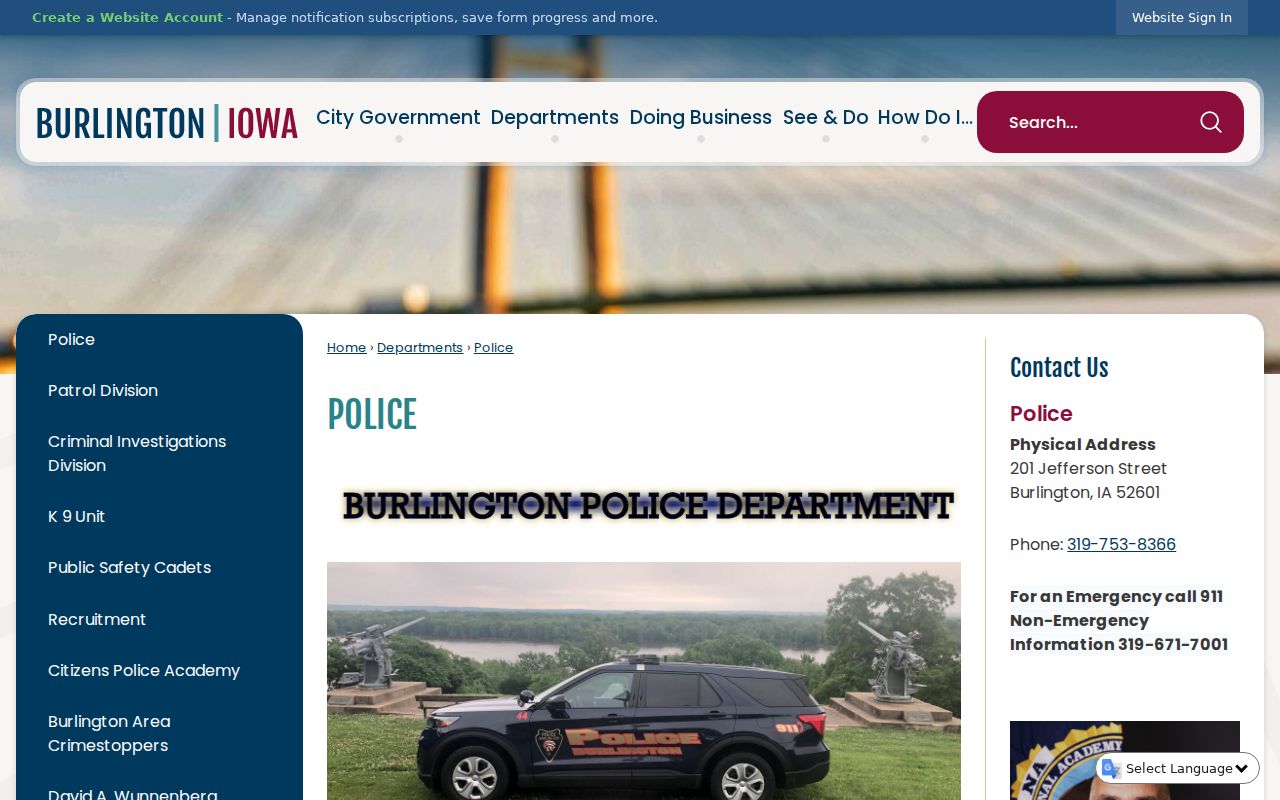
The source confirms that Burlington Police is the local records starting point, while dispatch, jail, and court channels answer different questions.
Before submitting the Burlington form, decide whether the goal is the officer's narrative, a call-history entry for one Burlington location, or an arrest record tied to a known event. Use the narrowest matching report type. A call for service can document dispatch activity without proving that an offense occurred, while an incident report can contain the investigated facts and an arrest report can explain the arrest decision. If the form response does not include a protected attachment, ask which Burlington policy applies and whether a public portion can be separated.
The Burlington Police Department
Burlington Police is located at 201 Jefferson Street, Burlington, Iowa 52601. The department number is 319-753-8366. DESCOM nonemergency dispatch is 319-671-7001, and Criminal Investigations is 319-753-8375. A records question belongs with the department, while a live nonemergency call for service belongs with dispatch. Crime Stoppers at 319-753-6835 is a tip route, not a Burlington personal-record lookup.
The Burlington police chief is the designated custodian for Burlington police records, yet police reports follow a separate policy from the Burlington general Chapter 22 process. That distinction matters. A requester seeking an arrest narrative should start with the dedicated police form instead of assuming the general city request will reach the same queue or use the same fee schedule.
Burlington Police and City Records Split
Burlington's general open-records policy covers non-police city material and expressly separates police reports. The general route can serve city council records or other municipal files, but the dedicated police route is the better fit for an incident or arrest report. Sending a police request through the broad city channel can add needless routing.
The official Burlington open-records policy documents that split and the general fee rules.
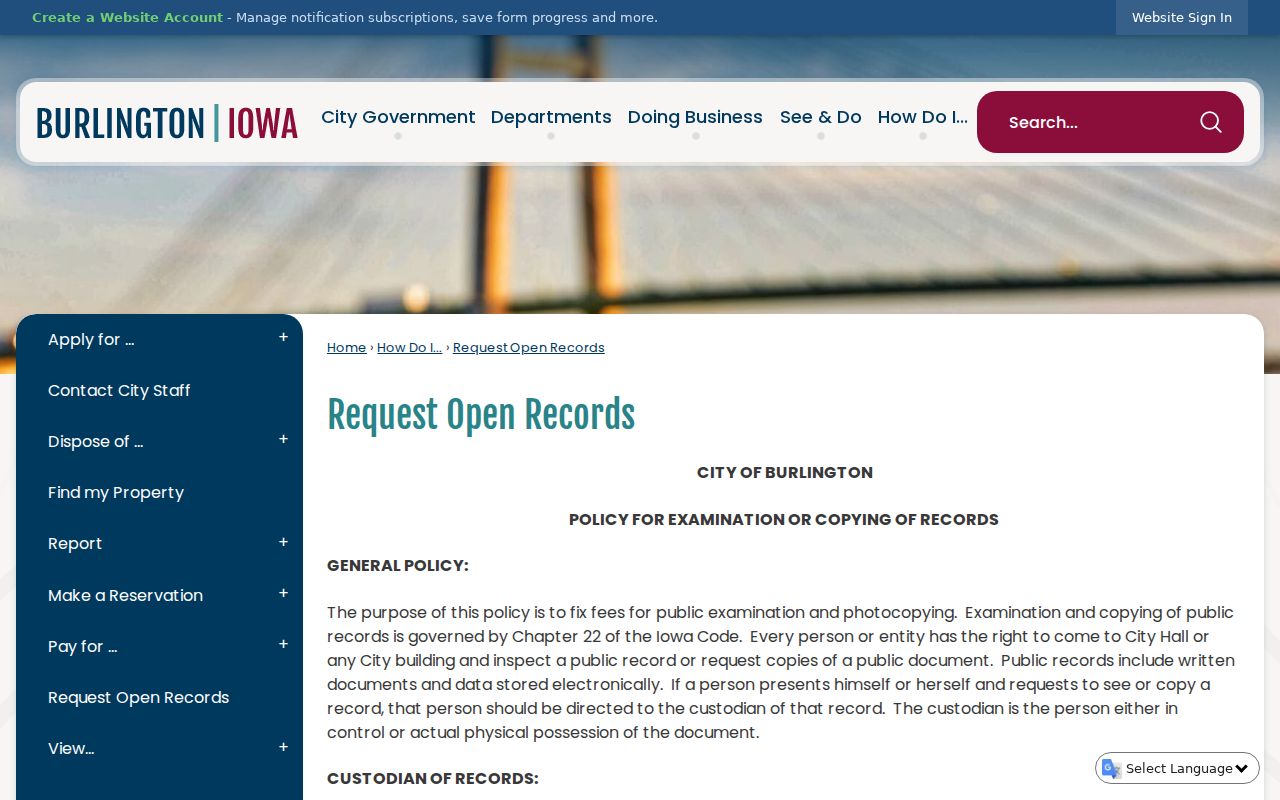
This policy source is useful for Burlington municipal records, but it cautions readers to use the separate police-report process for police material.
For a request that mixes Burlington police and other municipal material, separating the request by custodian can make the response easier to track. Use the police route for the Burlington agency report and the general route for council or department records. Record the date each Burlington request was sent and the estimate, if any, that came back.
Arrests and Bookings in Burlington
Burlington Police creates the incident and arrest narrative. If detention follows, the Des Moines County Correctional Center at 3630 Bauer Drive creates the booking and custody record. Its information number is 319-753-8275. No official public county jail roster was verified, so a Burlington search should use the jail telephone for present custody and the proper records request for a releasable booking record.
A filed case creates a third record in Iowa District Court. The arrest charge can change before filing, and a prosecutor may amend or decline a charge. For that reason, a Burlington police report should not be treated as the final case result. The county criminal court case record is the source for filed charges, docket events, judgment, and sentence.
Reading Burlington Police Activity Records
The September 2024 Burlington Police memorandum reported 1,864 incidents or calls and 112 arrests. It separately listed traffic stops, suspicious-person or vehicle calls, animal calls, domestic calls, welfare checks, theft calls, and collision or burglary categories. Those operational entries are not all arrests and are not convictions.
The listed arrest-charge categories also do not add to the stated arrest total. They should be read as the report's own categories, not recalculated into a new Burlington rate. The value of the memo is context: it shows how a monthly police activity record differs from a court disposition or an annual crime measure.
A careful Burlington reader can use the memo to identify the kinds of calls the department handled during that month, then request the particular Burlington report that matters. The totals do not reveal the facts of any one incident, the identity of a person, or the result of a prosecution. Those answers require the event-level police record and, if charges were filed, the matching court docket. This separation keeps routine service calls from being mislabeled as crimes and keeps arrest categories from being described as final convictions.
Burlington Municipal Court Records
Burlington has no municipal court and no city case-search portal. Iowa uses a unified Judicial Branch, so Burlington criminal and ordinance matters proceed in Iowa District Court. Search Iowa Courts Online first. If the public view does not expose a link or document, contact the Des Moines County Clerk at 513 North Main Street, Burlington, or 319-753-8262.
| Court Name | No Burlington municipal court; the court of record is Iowa District Court for Des Moines County. |
|---|---|
| Case Types Heard | Filed Burlington ordinance, misdemeanor, and felony matters within Iowa District Court jurisdiction. |
| Case Lookup Channel | Iowa Courts Online, followed by the Des Moines County Clerk and courthouse public terminal. |
| What the Docket Shows | Case ID, parties, filed charges, events, hearings, financial entries, judgment, sentence, and disposition as available. |
| Copies & Fees | Ask the clerk about lawful inspection or copies; phone cameras and recording devices may not be used in the courthouse. |
Burlington Police Annual Record Archive
Burlington's official annual-report archive reaches from 2004 through 2025. It gives a year-by-year city source for department activity and is a stronger way to compare official Burlington reporting over time than treating one monthly memo as a long-term trend.
The Burlington Police annual-report archive appears in the source image below.
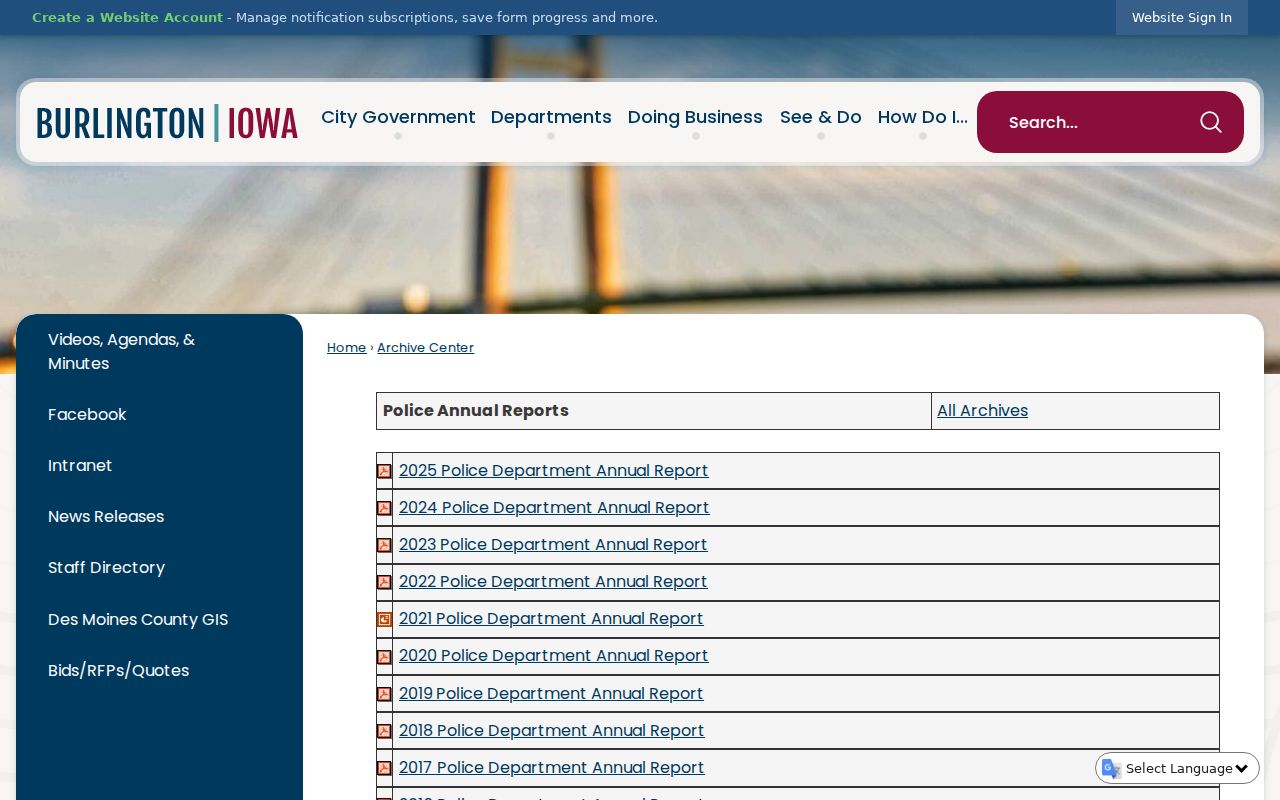
The archive provides local context, but each Burlington arrest or court outcome still must be checked in the record created for that event.
Where Burlington Records End Up
A Burlington arrest starts with the city police narrative. Detention creates a county booking entry, and a filed charge creates an Iowa District Court docket. Fingerprints support the arrest cycle sent to the Iowa Division of Criminal Investigation, while the court later reports the disposition. These systems may update at different times.
Record flow: Burlington Police Department › Des Moines County Correctional Center and Iowa District Court › Iowa Department of Public Safety, Division of Criminal Investigation
Use the city source for the recent event, the jail for custody, the clerk for the filed case, and DCI for its fingerprint-supported Iowa history. A gap in one Burlington channel does not prove the event never occurred.
Burlington Public Record Cost Thresholds
For general non-police Burlington records, Burlington lists black-and-white copies or scans at $0.20 per page, color at $1 per page when possible, a CD at $10, and a Burlington City Council DVD at $5. More than 25 pages or more than 30 minutes of staff time triggers $24 per hour in clerical time, prorated to 15-minute units.
An estimate above $10 requires requester agreement, while a cost above $50 can require estimated prepayment. The general custodian targets completion within 14 working days unless a disclosure or confidentiality issue intervenes. These are general Burlington city rules. They should not be assigned to a police report without confirming the separate police fee.
Burlington Historical Criminal Record Limits
Burlington's place as county seat makes downtown the center for filed criminal records, but historical coverage has a real local limit. A fire destroyed Mozart Hall and many county documents in 1873. The current courthouse was built in 1940 after an earlier stone courthouse had stood across the street.
For a genealogy or archival Burlington search, absence before the fire may reflect lost source material rather than no court activity. Modern Burlington records are also physically split: police at Jefferson Street, court and sheriff counters on North Main, and jail custody on Bauer Drive. Knowing the record type prevents a trip to the wrong office.
Bring a correctly spelled name, an approximate year, and a case number when one is known to the clerk. For a modern Burlington police event, use the CFS or incident number instead. The identifiers are not interchangeable: a police number tracks the agency file, while an Iowa court case ID tracks the prosecution. Recording devices and phone cameras are prohibited in the courthouse, so a Burlington visitor should arrange a lawful copy with the clerk instead of planning to photograph a public terminal.
Public Access Rules
Burlington police and city records are subject to Iowa public-access law, but public status is reviewed record by record. Confidential juvenile information, protected victim or complainant details, active investigative material, and personal identifiers may be withheld or redacted. A narrow request can help the custodian identify a releasable part without disclosing protected content.
Key Statutes:
Iowa Open Records Law, chapter 22 permits examination and copying of public records, allows lawful actual costs, and identifies confidential categories.
Iowa Code sections 692.2 through 692.4 govern DCI criminal-history dissemination and explain why authorization changes what may be released.
Iowa Court Rule 16.601 and following govern electronic court access without opening confidential court information.
If Burlington withholds part of a record, ask for the statutory basis and for any reasonably segregable public portion. A Burlington response, court docket, and DCI result can lawfully differ because each source has a distinct purpose and access rule.
Keep a short source log for a Burlington search: note the Burlington request date, Burlington incident number, county case ID, and DCI response date. That record makes it easier to spot which Burlington source is newer and which office should correct an error. It also prevents a result from one Burlington system from being mistaken for the complete Burlington criminal history.