
Running a Sex Offender Check in Des Moines County
The Iowa Sex Offender Registry, operated by Iowa DPS and DCI, is the main public source for a Des Moines County sex offender check. It is free and supports Basic, Advanced, Map, Telephone, and Email searches. A person who knows a name can start there. A resident who wants place-based awareness can use city, ZIP, county, or map tools instead. Telephone and email modes answer a narrower question: whether that contact information is tied to a registrant.
The registry says it generally updates hourly from Monday through Friday during business hours. That makes it the quickest documented public channel, but not a promise of real-time completeness. The Des Moines County Sheriff's Office maintains and proactively investigates local registrations. Contact law enforcement when a search raises an immediate safety concern or when the public record appears to conflict with what is happening at a location.
Des Moines County Registry Map
Place-based searching works well when the goal is neighborhood awareness rather than identifying one person. The registry includes a county heat map under Information and Web Stats, along with address-based location searches that require a mile range. A location query can use a street, city, state, and ZIP; a city, state, and ZIP; or a ZIP alone. Nearby-city and nearby-ZIP options widen other searches.
The official Iowa registry county map shows where a reader can begin a Des Moines County search.
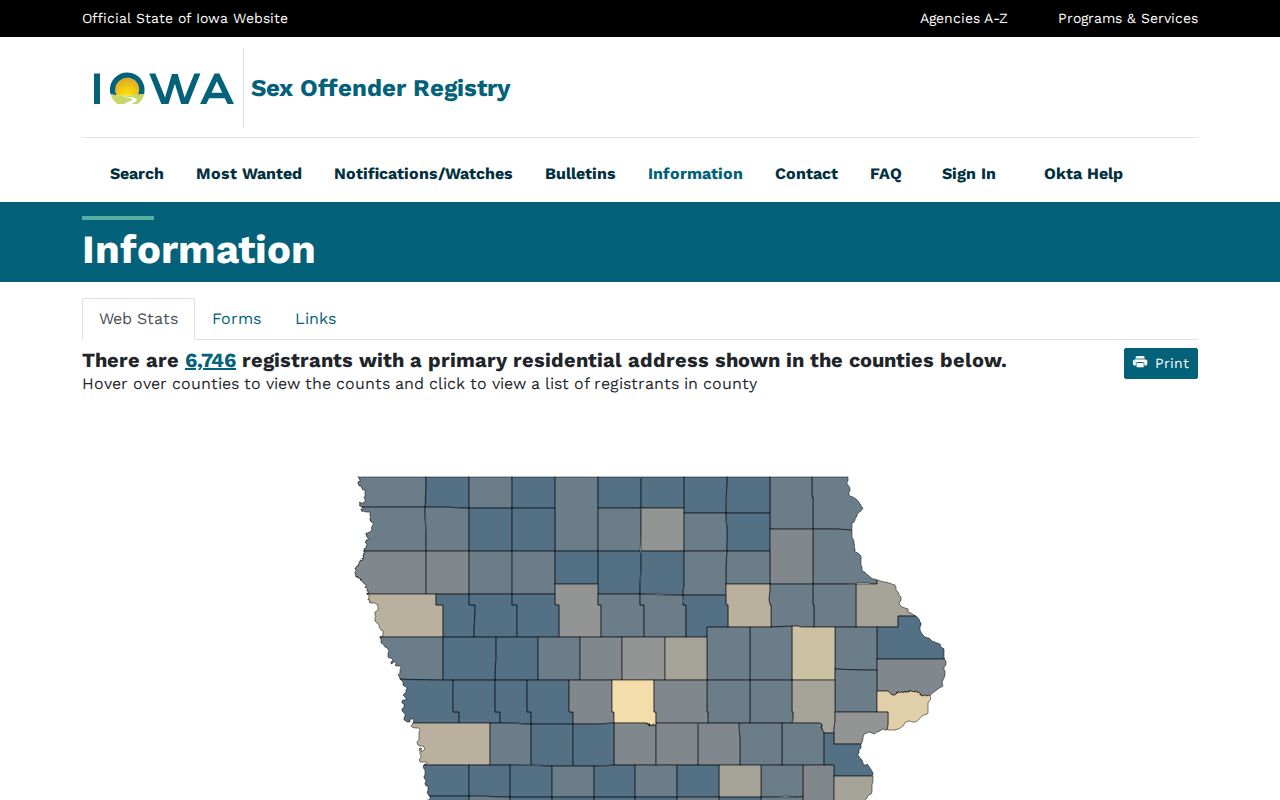
The map is a starting view, not proof that every marker reflects a person's current location at the moment of review.
Searching the Iowa Sex Offender Registry
Begin with the least broad set of facts that fits the purpose. A Des Moines County sex offender search by exact name may be clearer than a county-wide list. If spelling is uncertain, the official search supports first and last names that begin with the entered text, plus an alias option. Place filters can narrow a common name. Read the registry's public notice before relying on a match.
- Open the official registry and review its conditions and safety notice.
- Choose Basic, Advanced, Map, Telephone, or Email search based on the facts available.
- Enter a name, ZIP, city, county, or location range, then compare more than one identity field in the results.
- Open the profile, check its last-changed information, and contact police or the sheriff when urgent safety facts need confirmation.
The registry offers more than the basic page reveals at first glance. Its official data criteria document how searches and public fields work. These fields show how to refine a Des Moines County registry search without assuming unsupported profile details.
| Field label | Type | Required | Options or notes |
|---|---|---|---|
| Last name / first name | Text | No | Starts-with matching; alias search can be enabled |
| City / county / ZIP | Text or select | No | Nearby-city and nearby-ZIP options are available |
| Gender / age | Select or number | No | Gender uses male/female; age search allows a three-year range |
| Height / weight | Number | No | Height allows three inches; weight allows twenty pounds |
| Location and mile range | Address / number | Range is required | Street or ZIP-based location search |
| Telephone / email | Contact value | For those modes | Checks whether the value belongs to a registrant |
The official Iowa registry home page displays the basic search and notification entry points.
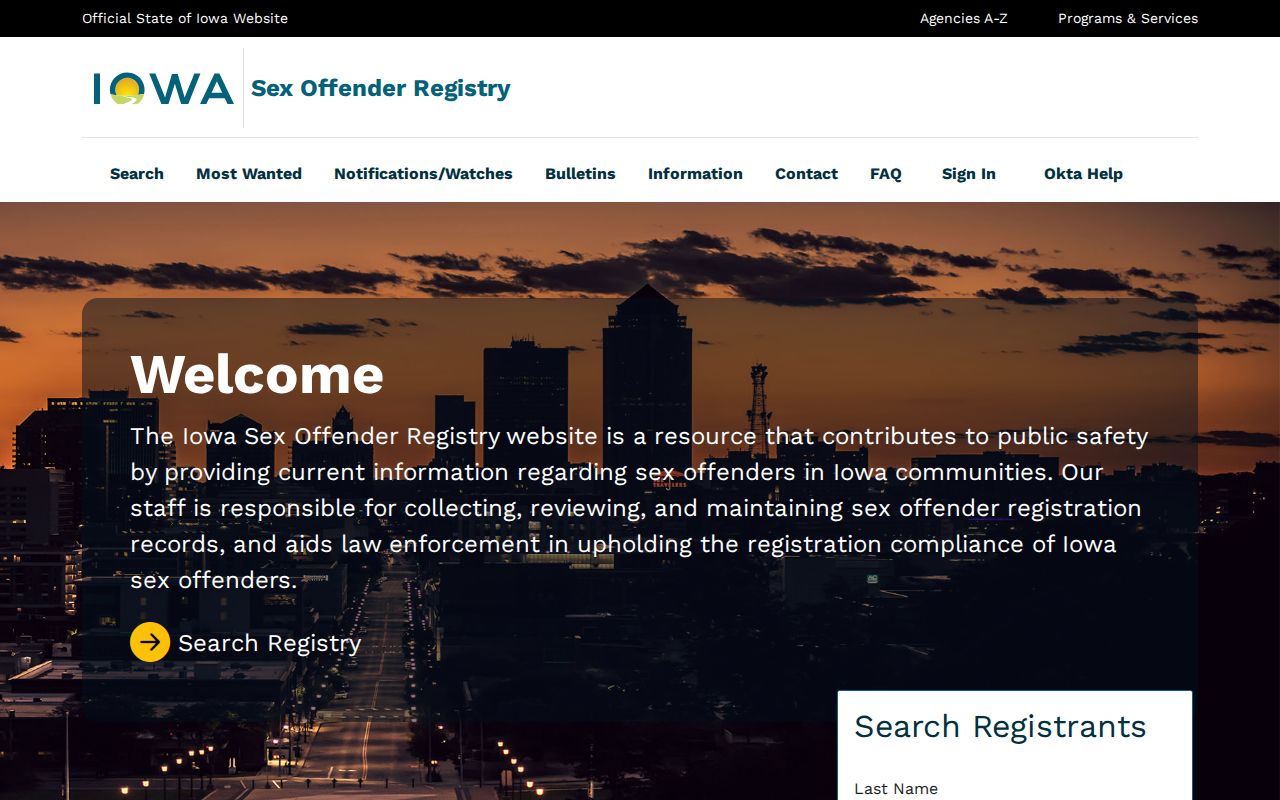
Its basic fields are useful for a first pass, while the advanced and map modes provide the more exact Des Moines County filters.
Des Moines County Registry Alerts
The Iowa registry's notification feature uses a free OKTA account and a tool called My Watches. After signing in, a user can save a watch tied to the supported registry criteria. The service states that email is sent within sixty minutes after registered information changes. That timing is an alert target, not a substitute for calling law enforcement when a threat appears imminent.
Alerts are most useful as a change monitor after the first Des Moines County sex offender check. They spare a reader from repeating the same search each day. A watch also differs from the public result page: the page shows what the registry currently publishes, while the watch is designed to notify the account holder when that registered information changes.
What a Registry Profile Shows
Official registry inventory documents identity, appearance, location, classification, conviction, and victim-category fields without requiring a private example. Match more than a name. Date of birth, photo, physical traits, OCI number, and address can help distinguish people with similar names. Distance from a searched address and the last-changed date add context to a place-based Des Moines County registry result.
| Name and identifiers | First, middle, and last name; aliases; system registrant ID; OCI number; date of birth |
|---|---|
| Photo and traits | Current photo URL, gender, race, hair and eye color, height, weight, and skin markings |
| Registered location | Address lines, city, state, ZIP, county, coordinates, and distance from a searched address |
| Classification | Iowa tier and wanted-status information where returned |
| Conviction context | Conviction text, age at offense, and victim gender and age-group categories |
| Update context | Last-changed date and registrant cluster count at an address |
The inspected inventory did not establish public vehicle, employer, school, exact conviction-date, or statute fields. Do not infer those facts from a blank field or from a profile captured elsewhere. For the filed criminal case and its outcome, use the court record rather than treating a registry entry as a full case file.
Des Moines County Registration Contact
The Des Moines County Sheriff's Office lists maintaining and proactively investigating the sex offender registry among its duties. Its business office is at 512 North Main Street in Burlington and can be reached at 319-753-8212, Monday through Friday from 8:00 a.m. to 4:30 p.m. The official county material inspected did not say whether registration occurs by walk-in or requires an appointment.
Call before arriving for registration business. That avoids assuming that the public clerical counter is the correct check-in point. The sheriff can also receive local information about a possible compliance problem, while Iowa DCI runs the public statewide system and its technical registry channels.
Des Moines County Sheriff
512 North Main Street
Burlington, IA 52601
319-753-8212
Monday through Friday, 8:00 a.m. to 4:30 p.m.
Registration Requirements and Levels in Iowa
Iowa Code chapter 692A uses Tier I, Tier II, and Tier III offense classifications. A tier is not an individualized public risk score. Section 692A.102 classifies covered offenses, while §692A.106 governs duration and statutory exceptions or tolling. A case-specific duration should be verified against the current statute because special sentences, repeat status, and other provisions can change the result.
| Tier | General duration | General verification |
|---|---|---|
| Tier I | Ten years | Annual |
| Tier II | Ten years, subject to statutory distinctions | Semiannual |
| Tier III | Lifetime | Quarterly |
Specified sexually violent, special-sentence, and repeat statuses can require lifetime registration. Section 692A.108 sets the general verification schedule. Section 692A.110 addresses the annual registration fee and civil penalty. These duties belong to registrants and supervising agencies; the public tier label should not be turned into a prediction about future conduct.
Des Moines County Distance Rule
Iowa's 2,000-foot restriction is often misunderstood. Section 692A.114 does not impose the same residency rule on every person listed in Des Moines County. It applies to the statutorily covered group whose offense involved a minor and includes exceptions. The offense, status, location, and current statutory text all matter.
A map marker alone cannot settle whether a residence violates the law. The public should avoid measuring a line on a consumer map and declaring noncompliance. Report a concrete concern to the Des Moines County Sheriff, which can compare the facts with registration records and the legal exceptions. This keeps a safety concern in the hands of the agency charged with investigation.
Des Moines County and NSOPW
The Iowa registry provides state-level detail and local Des Moines County filters. The National Sex Offender Public Website, maintained by the U.S. Department of Justice, adds a cross-state search layer. NSOPW is useful when a person may have moved or when a search area crosses Iowa's border. Iowa's own registry remains the better place for Iowa search modes, alerts, and state-specific notices.
Neither source is a full criminal history. Registry status is a Chapter 692A record with a public-safety purpose. Court dockets and DCI criminal-history records answer different questions about charges, dispositions, and broader Iowa history. Compare the right source to the question instead of treating a registry match as the whole record.
Des Moines County Noncompliance Searches
The registry's Most Wanted page is not a general list of all people registered in Des Moines County. It identifies noncompliant registrants with active warrants. The official warning says not to apprehend them. Use the basic, advanced, county, or map tools for an ordinary registry check.
The official Iowa Registry Most Wanted page shows the distinct warrant and noncompliance purpose.
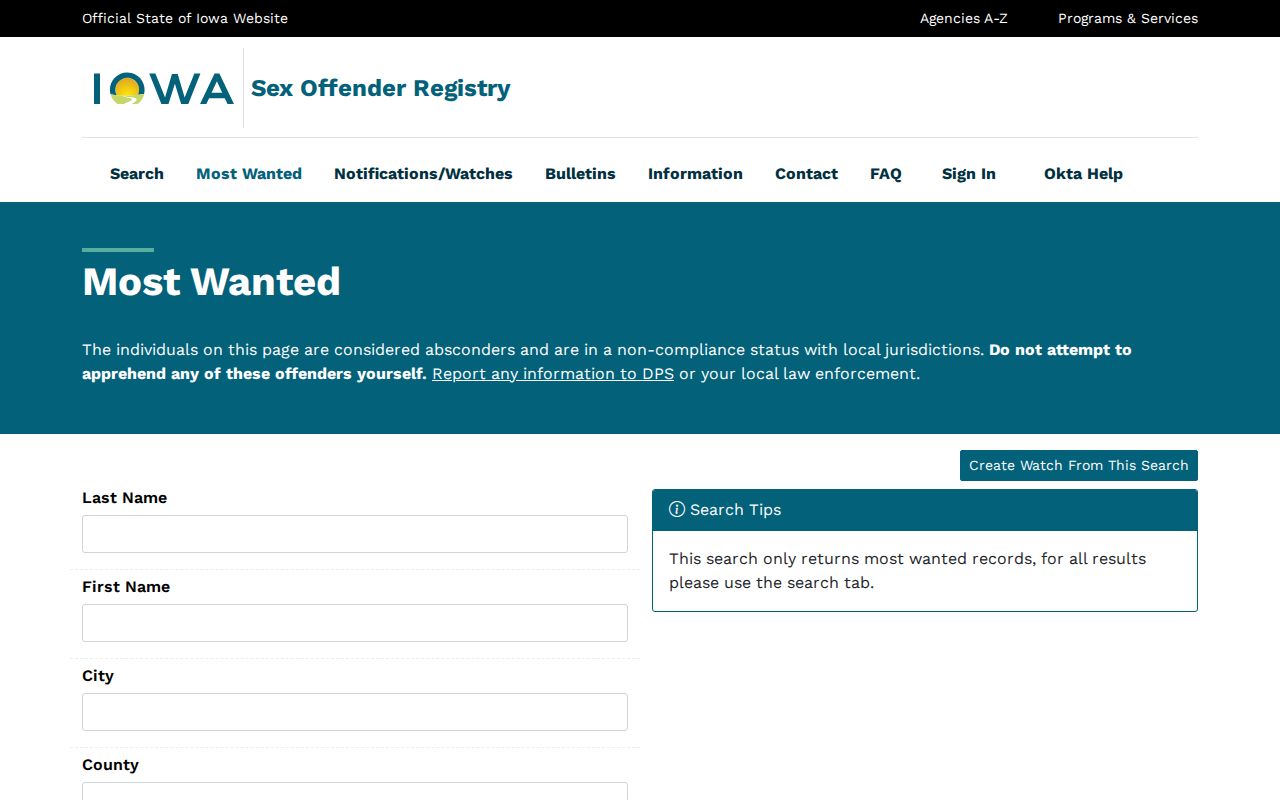
A possible sighting or urgent threat belongs with law enforcement, not with a private attempt to confront or detain anyone.
Lawful Use and Community Notification
Registry information supports personal, family, and neighborhood safety. Iowa Code §692A.121 controls what registry information is available to the public and what remains withheld. The registry itself cautions that the website is not the entire list. If the facts suggest a crime may occur, contact police or the Des Moines County Sheriff rather than relying on a web result alone.
Use Des Moines County registry information to plan safe choices and identify the correct public agency. Do not threaten, harass, intimidate, discriminate against, or attempt to apprehend a registrant or anyone in the household. A profile can be wrong, stale, incomplete, or misunderstood, and an apparent match may belong to a different person.
Use is limited by Iowa law: Misusing registry information to harass, threaten, or intimidate can violate Iowa criminal law. Iowa Code chapter 692A governs public registry access, and the registry directs users to law enforcement rather than vigilante action.