
Criminal Cases in the Des Moines County Courts
Des Moines County is part of Iowa Judicial District 8. Iowa District Court handles ordinary criminal prosecutions here, including felonies and the state's simple, serious, and aggravated misdemeanor case types. Iowa does not place those matters in a separate county criminal court. The Des Moines County Attorney prosecutes state cases, but filed complaints, trial informations, motions, orders, judgments, and sentences become court records held through the Judicial Branch and the Clerk of Court.
The clerk is at the Des Moines County Courthouse, 513 North Main Street, Burlington, Iowa 52601. Mail goes to P.O. Box 158. The main number is 319-753-8262, the fax is 319-753-8253, and the email is countyclerk.desmoines@iowacourts.gov. Ordinary hours are weekdays from 8:00 a.m. to 4:30 p.m. The clerk is the right office for a filed case, while an officer narrative remains with the agency that made the report.
Des Moines County Case Portal
There is no separate Des Moines County criminal-case portal. The official route is Iowa Courts Online, backed by the Burlington clerk when the public view stops short. The system searches cases across Iowa, so county selection and the spelling used in the file matter. A Case ID opens the available details. Schedule Search and Trial Court Advanced Case Search require an Online Search subscription, and some document links work only for subscribers or at a clerk public terminal.
The official Iowa Courts Online entry is shown in the Judicial Branch search source below.
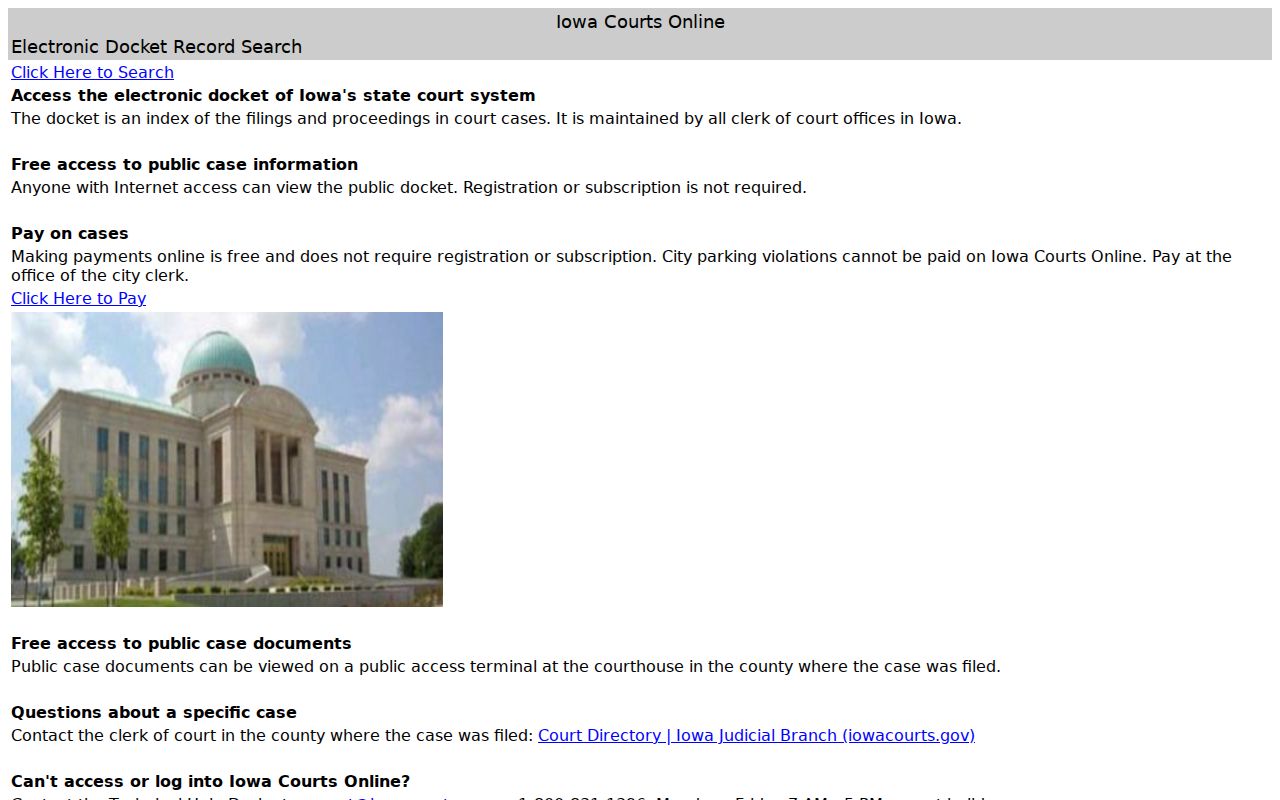
That statewide entry point explains why Des Moines County case research begins with Iowa Courts Online rather than a county-built docket site.
How to Search Case Records
Start with the narrowest reliable identity and keep the Case ID. The official Iowa Courts Online help documents the name rules, wildcard, Boolean choices, and access limits. A web result is an index into the Des Moines County court record, not a guarantee that each underlying document can be downloaded.
- Open Iowa Courts Online and choose the name-search route for trial court cases.
- Enter at least two letters in Last/Firm Name, with the spelling used in the case. A first-name initial should have no period.
- Use Des Moines County as a filter when available. Use
%as a wildcard, or AND and OR when searching two names. - Open the Case ID and read the events through disposition, judgment, and sentence instead of stopping at the first charge.
- Contact the Burlington clerk with the Case ID to inspect the public file, use the public terminal, or ask about a lawful copy.
| Field or control | Type | Required | Official behavior |
|---|---|---|---|
| Last/Firm Name | Text | Yes for name search | At least two letters; exact case spelling; % works as a wildcard |
| First Name | Text | No | Do not put a period after a one-letter initial |
| Other name fields | Text | No | May narrow the identity |
| AND / OR | Search logic | No | AND requires both names in one case; OR returns either |
| Case ID | Result link | N/A | Opens available case details |
| Schedule / Advanced Search | Separate tools | Subscription | Online Search subscription required |
When two names appear in one Des Moines County matter, AND finds a case containing both while OR finds either. The wildcard helps when the exact ending is uncertain, but it can broaden results. Confirm identity from the court record rather than assuming that a matching name belongs to the person sought.
Des Moines County Clerk Case Terminal
A link that does not work from home may still work at the clerk's public access terminal. The official help distinguishes the basic public web view from subscriber and courthouse access. Ask the Des Moines County clerk whether the needed docket entry or filing is open, how it may be inspected, and what a copy or certification will cost. The research did not establish a local flat copy fee, so the clerk should confirm it before an order is placed.
Plan for courthouse rules. Parking is available on the north side, along Main Street and nearby streets, or at the riverfront. Weapons are prohibited. Phones must be turned off, and phone cameras and recording devices may not be used. Those limits make a clerk-supplied copy more practical than trying to photograph a screen. Bring the Case ID, or the correctly spelled party name and an approximate filing year if the number is unknown.
What the Case File Shows
A Des Moines County criminal case file records what prosecutors filed and what the court did. It is distinct from the booking sheet and the arresting officer's narrative. No private person's sample docket was used in the research, so the inventory below describes supported court-record categories without promising that every public web result shows every field or document.
| Case ID and parties | Identifies the Des Moines County action, court category, and named parties. |
|---|---|
| Charging document | May include a complaint, trial information or indictment, and later amendments. |
| Docket events | Chronological entries for filings, hearings, motions, orders, and other case activity. |
| Hearings and pleas | Shows scheduled proceedings and the formal response to filed charges when public. |
| Disposition and judgment | Records dismissal, acquittal, conviction, discharge, or another final court result. |
| Sentence and finances | May show the sentence, restitution, court financial entries, and related orders. |
Financial entries may reflect costs, fines, fees, or restitution, but the last docket line may not explain the whole result. Read the judgment and sentencing entries together. If a linked order is not open on the public web, use the Case ID when asking the Des Moines County clerk whether the document is available at the public terminal or by copy request.
Des Moines County Case Prefixes
Iowa case prefixes tell a reader the case category, not whether the accused was found guilty. Reading a Des Moines County docket by prefix alone can turn a filing label into a false conclusion. The useful question is what happened after filing.
- FECR
- A felony criminal case category.
- AGCR
- An aggravated misdemeanor criminal case category.
- SRCR
- A serious misdemeanor criminal case category.
- SMCR
- A simple misdemeanor criminal case category.
- OWCR
- An operating-while-intoxicated criminal case category.
A trial information is the prosecutor's formal charging instrument. Minutes of testimony summarize expected witness or evidence material filed with it. Later amendments, a plea, verdict, dismissal, judgment, and sentence determine the case's true course. The prefix remains useful for sorting records, but it is not an outcome code.
Stages of a Criminal Case
The Des Moines County court file begins when a charge is filed, not merely when an arrest occurs. A complaint may start or support the prosecution. A trial information or indictment can supply the formal charge. Arraignment is the stage where the charge is addressed and a plea is entered. Pretrial entries may reflect motions, hearings, discovery issues, amendments, or negotiated pleas. A trial may end in acquittal or conviction, while a dismissal ends the filed charge without a conviction.
Case flow: Charges Filed › Arraignment › Pretrial › Plea or Trial › Disposition › Sentencing
Read each Des Moines County case through the last public entry. A filed charge can be amended, and a sentence appears only after a conviction. For the arrest and booking documents that precede court filing, use the separate Des Moines County arrest history channels.
Des Moines County Disposition Check
The first charge is an allegation, not the final result. A police report states the arresting agency's account. A jail record reflects custody and the charge or hold known at intake. The Des Moines County court docket then shows what prosecutors actually filed. It can record amendments, dismissal, plea, trial, judgment, sentence, or a deferred judgment. These sources may differ without any one record being false because each captures a different step.
When a court disposition has not reached the Iowa Division of Criminal Investigation, verify the order with the clerk first. Then email dci-criminalhistory@dps.state.ia.us with the disputed item and the case or order details. DCI may ask for fingerprints because its repository is fingerprint-supported. A court-level deferred-judgment expungement also does not erase the DCI entry: DCI says it retains a discharged nonconviction record and releases it only with signed authorization.
Des Moines County Defense Record
The Burlington State Public Defender is at 216 South Third Street, Burlington, Iowa 52601, and its telephone is 319-753-5163. It serves qualifying court-appointed cases, but it is not the public custodian of the court docket. The Des Moines County clerk remains the public record route, while counsel uses the case materials needed for representation.
The official Burlington public defender source is represented below.
This local office helps distinguish a defense contact from the clerk counter where the public asks to inspect a Des Moines County case file.
Access & Restrictions
Iowa Court Rule 16.601 and related court access rules govern electronic records. A subscription does not make confidential content public. If confidential information appears by mistake, the Iowa Courts Online instructions say not to use or spread it and to report it to the clerk or Judicial Branch support. Most juvenile court records are confidential under Iowa Code §232.147, even though the juvenile office shares the courthouse.
Iowa Code chapter 22 permits inspection and copying of public records but also recognizes confidential categories. Protected victim information, personal identifiers, expunged records, sealed material, and information restricted by statute, rule, or order may be withheld or redacted. When a Des Moines County case does not appear online, ask the clerk whether the record is unavailable on the web, accessible only at the terminal, archived, confidential, or expunged. Absence from a public search is not proof that no court event occurred.